
Raw Honey vs Creamed Honey, what's the difference?
February 11, 2026
Share this post


Essential takeaway
Raw honey is honey that has not been heated over 65C in order to maintain its natural enzymatic properties. Therefore, raw honey may be liquid or creamed, as dictated by honey type.
Although some types of honey (such as Honeydew and Thyme) remain stable in a liquid state, others (such as Manuka honey) are more likely to crystallise faster over time, reducing their shelf life and quality.
Creamed honey is another form of raw honey, with crystallisation carefully controlled to create a smooth, spreadable texture without altering its composition.
Quick answer
Raw honey may be in creamed or liquid form.
Liquid honey
- Processing: Lightly filtered (150 micron standard), to remove natural impurities; not thermally treated
- Texture: Viscous, smooth
- Taste: Strong, varies by flower
- Crystallisation: Happens naturally
- Additives: None
- Best for: Culinary uses, health & wellness
Creamed honey
- Processing: Controlled crystallisation
- Texture: Smooth and spreadable
- Taste: Mild, even
- Crystallisation: Controlled and stabilised
- Additives: None
- Best for: Spreads, baking, gifting, specialty foods, and entertaining
What is Raw honey?
Raw honey is non pasteurised honey taken directly from the beehive and prepared via fine filtration and without high heat to preserve the enzymatic richness of its’ natural state.
After harvest, it is extracted and filtered using simple mechanical methods to eliminate the risk of foreign objects remaining in the final product.
There is no need for pasteurisation (which occurs at high temperatures) or chemical treatment, as the existing processing yields clean, high-quality honey with natural levels of pollen, enzymes, and fine wax particles.
How Raw honey is processed
Raw honey is processed using simple mechanical steps that preserve its natural state.
- Extracted from the honeycomb
- Filtered at 150 microns to remove debris and retain natural levels of pollen and enzymes
- Honey is jarred without heating, so it may appear cloudy and crystallise naturally
- Processing and labelling follow food safety rules, including the New Zealand Food Standards Code.
Texture and crystallisation
Raw honey changes texture over time because its natural sugars slowly form solid crystals within the liquid honey.
- Honey contains mostly glucose and fructose and glucose naturally forms crystals
- Cooler temperatures speed up crystallisation
- Crystallisation is normal and does not mean the honey is spoiled
- Different floral sources crystallise at different rates
- Clover honey crystallises quickly, while Mānuka honey crystallises more slowly
Flavour and appearance
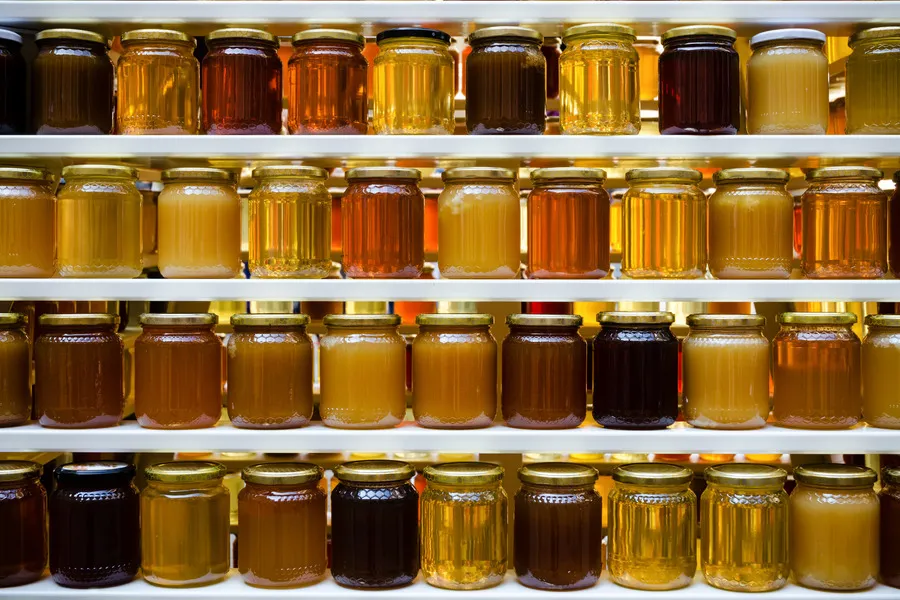
Raw honey shows clear differences in flavour and appearance because its natural floral compounds are not altered by heat or fine filtration. Its taste, aroma and colour closely reflect the nectar source, ranging from pale gold to deep amber.
Monofloral Raw honey tends to have a more consistent flavour, while multifloral Raw honey is more complex and variable. In New Zealand, Raw honey also varies by region, climate and flowering season, adding further diversity in taste and colour.
Characteristics of Different types of Raw honey
- Raw Mānuka: Rich, earthy flavour, dark colour, slow to crystallise, premium use
- Raw Clover: Mild, sweet, light colour, crystallises quickly, everyday use
- Raw Wildflower: Mixed floral flavour, colour and taste vary by season
Why buyers choose Raw honey
Many buyers choose Raw honey because it is processed without being pasteurised (heated to 80 degrees C), which can damage honey. Heat damage has been shown to reduce invertase enzyme activity by 98%, which adds nutritional value to honey. Additionally, it can reduce hydrogen peroxide volume in honey, stripping it of the associated antibacterial properties.
Warming honey at lower temperatures allows its floral compounds remain intact, so the flavour reflects the nectar source more clearly. This profile retains naturally occurring antioxidants and enzymes, rendering Raw honey particularly appealing for premium products and specialty ranges.
What is Creamed honey
Creamed honey is sometimes called whipped, soft-set, or spun honey and differs only in crystal structure, not in ingredients or purity. Creamed honey that has not been pasteurised is considered to be ‘Raw’.
How Creamed honey is made
Creamed honey is made by guiding natural crystallisation so that many tiny crystals form evenly rather than a few large ones, creating a smooth, spreadable texture.
- The process starts with liquid honey before large crystals have formed naturally
- Fine seed crystals are introduced, so new crystals grow small and uniform rather than large and gritty
- The honey is kept at a cool, stable temperature to allow slow, even crystallisation
- Gentle movement helps distribute crystals evenly throughout the honey as they form
- Once the crystal structure is stable and smooth, the honey is ready for packing and storage.
Common Myths About Creamed honey
Creamed honey is often misunderstood, but most concerns come from confusion about how it is made rather than what it contains.
- Creamed honey does not contain cream, dairy, or any added fats
- It does not contain added sugar, syrups, or thickeners
- It is not diluted with water or blended with other sweeteners
- It is not cooked or pasteurised to create its texture
- It is still 100 percent pure honey, only the crystal structure is different
Texture and flavour
Creamed honey has a smooth, uniform texture and a mild, balanced flavour because its crystals are tiny and evenly distributed. This fine crystal structure makes it easy to spread and keeps the honey soft and stable at room temperature without becoming grainy or hard. The process does not change the honey’s composition; it remains 100 percent natural honey.
Different types of Creamed honey
Different types of Creamed honey are created from different base honeys, which affect flavour, colour and richness.
Creamed Manuka
Rich but softened flavour, thick smooth texture, premium spread.
Manuka honey’s rich yet softened flavour and its thick, smooth texture make it an exceptionally versatile premium spread. It’s perfect on toast, stirred into hot drinks, swirled through yoghurt, or paired with cheeses; offering luxurious depth and natural complexity.
Creamed Clover
Very mild, slightly floral flavour, pale colour, soft and easy to spread.
Creamed clover honey is known for its very mild, delicately floral sweetness and its light, pale colour. Its flavour profile makes it a widely enjoyed honey variant, often incorporated into baking, lighter additions to desserts, and added to teas and other warm drinks. It offers gentle sweetness without overpowering flavours.
Creamed Kanuka
Floral flavour, light amber colour, creamy texture
Creamed kānuka honey is known for its light, floral flavour, a hallmark of kānuka nectar, which produces a delicate, subtly sweet honey distinct from the stronger taste of mānuka.
Its lightly floral taste makes it a common choice for daily sweeteners for cereal, desserts or warm drinks. Many consumers choose to apply Kanuka honey as a floral facemask to promote wellness.
Creamed Wildflower
Balanced flavour from mixed florals, creamy consistency
Our creamed wildflower honey is a fusion of New Zealand pasture and bush honey. It
draws its balanced flavour from the diverse mix of floral nectars bees collect within their foraging range. A highly versatile honey, the wildflower variant is often included in baking, cooking, desserts, spreads and drinks.
Flavour Creamed honey
Gently blended with natural ingredients such as spices, fruit or herbs.
This allows for popular flavour combinations like honey and lemon, honey and ginger, predominantly enjoyed as spreads. Honey and Vanilla is a success in the dessert and coffee space, bringing a unique element of sweetness to a variety of dishes.
Why buyers choose Creamed honey
Buyers choose Creamed honey because controlled crystallisation creates a consistent, easy-to-use product that performs well in retail and foodservice settings. The fine crystal structure produces a smooth, uniform texture that spreads easily without dripping or hardening. This stability helps the honey resist large crystal formation and remain soft at room temperature, while its mild, even flavour makes it well suited to spreads, cafés and packaged products.
Which honey type should you choose?
The choice depends less on quality and more on how the honey is processed and used.
Choose Raw honey if:
- You value minimal processing
- You sell premium or specialty honey
- You want strong floral character
- You accept natural variation
Choose Creamed honey if:
- You need consistency
- You want easy spreading
- You sell through supermarkets or cafés
- You use honey in recipes or baking
As a rule of thumb, “raw” describes how honey is processed, while “creamed” describes its texture. Raw honey is unpasteurized, and creamed honey may still qualify as raw when it is prepared without pasteurization.
Raw vs Creamed Mānuka honey
Both Raw and Creamed Mānuka honey can be unpasteurized and classed as raw. The difference is not potency or purity, but format, how the honey is prepared for consistency, use, and application.
Creamed Mānuka honey is raw honey that has undergone controlled crystallisation, resulting in a smooth, spreadable texture that remains stable over time.
Buyers typically choose between Raw and Creamed Mānuka honey based on:
- Raw Mānuka honey is chosen for high UMF or MGO levels, premium positioning and direct wellness use
- Creamed Mānuka honey is chosen for everyday use, consistent texture and better suitability for foodservice and retail industry
- Buyers seeking health benefits tend to prefer Raw, high-grade Mānuka
- Buyers using Mānuka in drinks, food or daily routines often choose Creamed for convenience and consistency
In practice, both formats may be raw and unpasteurized. The choice between Raw and Creamed Mānuka honey comes down to how the honey will be used, whether for high-potency wellness applications or for consistent, everyday enjoyment.
Raw vs Creamed Honey, Floral Types Compared
The honeys below are named by the plants they come from, and each can be sold as both Raw and Creamed honey.
- Rātā honey: Naturally a Raw honey from rātā nectar, it can also be processed into Creamed honey if crystallisation is controlled.
- Beech honeydew: A Raw honeydew honey that stays liquid for a long time and is usually sold Raw.
- Kāmahi honey: A light nectar honey that often crystallises naturally and can be sold Raw or turned into Creamed honey for a smooth texture.
- Thyme honey: An aromatic nectar honey that is usually sold liquid and Raw. It can be converted into Creamed honey.
- Rewarewa honey: A dark nectar honey that is naturally slow to crystallise and sold Raw, but it can also be made into Creamed honey.
How each honey performs in commercial use
Raw honey in commercial use
Raw honey is valued for its natural character, but depending on how it is prepared, it can be harder to manage at scale. Without an expert Mānuka producer, honey;
- Can crystallise or harden unpredictably
- May separate or change texture during transport
- Often needs gentle warming before pouring or filling
- Varies between batches due to floral source and season
This makes raw honey well suited to premium and niche products, but if the supply chain is not managed properly it can create challenges for automated production and consistent retail or bulk supply.
Creamed honey in commercial use
Creamed honey is chosen for its shelf stability and consistency in production.
- Keeps a stable and uniform texture
- Does not separate or harden unexpectedly
- Works well with automated filling and portioning
- Performs reliably in baking, spreads and foodservice
Collectively, these attributes make creamed Mānuka honey well suited to a wide range of business applications, including but not limited to retail, manufacturing, café and foodservice operations, private‑label programs, export supply, and premium hospitality environments.
Key Takeaways
Raw honey and Creamed honey are both natural honey products, with the difference lying in how crystallisation is managed rather than in quality. Raw honey is left to crystallise naturally, which creates variation in texture, flavour and appearance, while Creamed honey uses controlled crystallisation to produce a smooth, shelf-stable, spreadable and consistent product. Each format suits different uses, markets, and production needs.
Key Points
- Raw honey suits premium, artisanal, and high-grade Mānuka markets where natural character are valued.
- Creamed honey suits retail and foodservice where consistency and ease of use matter.
- Raw honey can be harder to manage at scale when crystallisation is not controlled, due to natural batch variation.
- Creamed honey performs better in commercial settings as it stays stable, does not separate, and supports automated filling.
- For Mānuka buyers, premium positioning and high potency are closely tied to raw, minimally processed honey, while creaming controls the natural crystallisation to ensure the stability required for everyday and higher volume markets
references
Ministry for Primary Industries: Introduction to honey and bee product processing
National Centre for Biotechnology Information: Analysis of sugar crystal size in honey
Apiculture New Zealand: New Zealand honey story
The New Westminster’s Beekeeping Association: Processing Creamed honey
Science Direct: Phenolic compounds and methylglyoxal in some New Zealand Mānuka and Kanuka honeys
European Commission: Enhancing the quality attributes of processed honey and avoiding its crystallisation by the application of a non-thermal treatment process
Midlands: New Zealand’s specialty honey
Clover honey: Clover honey



Quick Navigation
Contact our team

Australia

New Zealand

New Zealand

Tasman Walker
BCom (Mktg) | BSc (Psy)
Honey Sales - Asia & Australia
Midlands Apiaries
+64 27 237 6318honey@midlands.co.nz
Hamish Finnie
BSc (Food Sc. & Hum. Nutr.)
Honey Sales - Greater China Region
Midlands Apiaries
+64 27 405 1273honey@midlands.co.nz

Nick Kerr
BCom (Hons)
Honey Sales - North America & Europe
Midlands Apiaries
+64 27 807 9849honey@midlands.co.nz

.webp)
%205_Website_-_Resources_Card_750x500.webp)



