How to Fix Crystallised Honey (Safe & Easy Methods)
May 7, 2026
Share this post


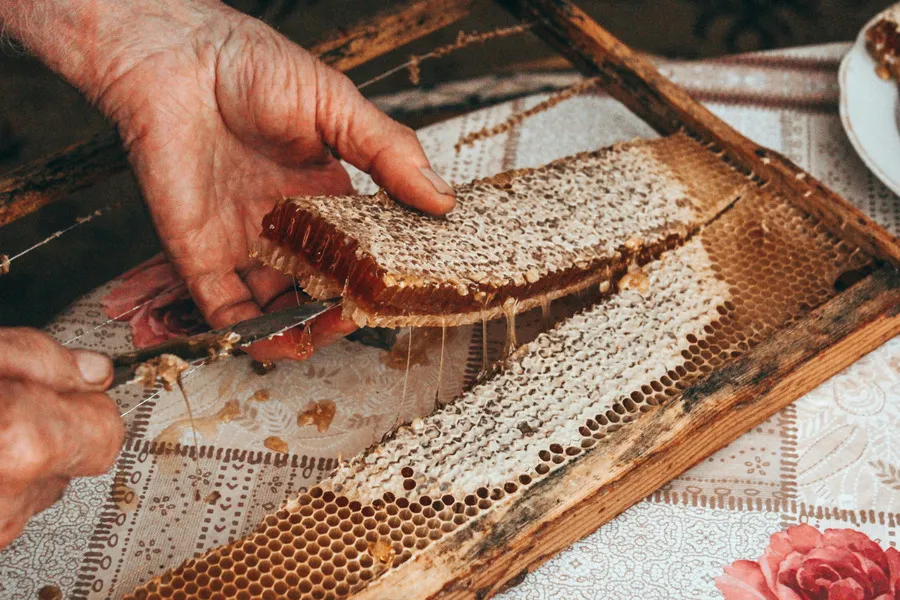
Crystallised honey is completely safe and easy to fix. It happens naturally over time and does not mean the honey is bad. In most cases, you can return honey to liquid in under 30 minutes using gentle heat. This guide explains why honey crystallises and how to fix it safely.
What Is Crystallised Honey?
Crystallised honey is a grainy, semi-solid form of standard liquid honey. Some honey lovers may mistakenly view crystallised honey as ‘old’ or ‘off’, but we can assure you this is not the case.
Crystallisation is a natural process that produces honey just as healthy and enjoyable as its liquid counterpart.
Why Does Honey Crystallise
Crystallisation occurs when a substance has a larger percentage of sugar than water. Because honey is made up of roughly 80% sugars (mainly glucose and fructose) and less than 20% water, it forms a supersaturated solution, in which the sugars gradually separate over time.
Glucose is less soluble than fructose, so it forms crystals first. As these crystals grow, the honey thickens and becomes grainy.
Several factors can speed up this process:
- Low water content (around 16–18%)
- Cooler temperatures (below 14°C)
- Higher glucose levels in certain honey types
- Natural particles such as pollen and beeswax
These natural particles serve as a base for crystal formation, which is why raw, minimally processed honey often crystallises more quickly.
In fact, crystallisation is often an indicator of authentic, high-quality honey. This natural process is widely recognised by industry bodies such as the British Beekeepers’ Association.
Here at Midlands Apiaries, we take a controlled approach to crystallisation in our honey. Creamed honey is already finely crystallised, producing a smooth, uniform texture that remains stable throughout its shelf life. This means it will not form the coarse crystals described here. Liquid honey may crystallise over time, but this is carefully managed to ensure consistent quality. Crystallisation may be visible in some Midlands Honey because natural particles such as pollen and fine wax are carefully preserved during processing.
Safety and Quality Considerations
Crystallised honey is completely safe to eat. It only changes in texture, not quality. When reheating honey, use low, gentle heat. Temperatures above 40°C can damage flavour and reduce the levels of beneficial compounds.
High heat can also increase compounds like HMF, which indicate heat damage in honey. To protect quality, always decrystallise honey slowly and avoid direct or high heat methods.
How to Liquefy Crystallised Honey
Crystallised honey is safe to eat and only changes in texture, not quality. If you prefer it in liquid form, you can easily restore it using gentle heat.
The best method is a warm water bath, as it heats the honey evenly while preserving its natural flavour and beneficial properties.
Many people also enjoy crystallised honey for its thicker, spreadable texture. If you prefer a smoother consistency, use one of the methods below to return it to liquid.
The Warm Water Bath Method (Best Method)
This is the safest and most reliable way to decrystallise honey. It provides gentle, even heat and preserves flavour and nutrients.
Steps:
- Fill a pot with warm water (below 40°C or 104°F)
- Place the sealed honey jar in the water (lid above water level)
- Leave for 20–30 minutes
- Stir occasionally until smooth
- Remove and store at room temperature
Tip: Keep the temperature low to avoid damaging the honey’s natural properties.
Double Boiler Method
This method is slightly faster but requires more attention to avoid overheating.
Steps:
- Fill a bowl with hot (not boiling) water
- Place the honey jar into the bowl
- Leave for around 30 minutes
- Stir and check consistency
- Repeat if needed
Tip: Use glass containers for more even heating.
Sous Vide Method
This method offers precise temperature control and works well for larger amounts of honey.
Steps:
- Set sous vide to 30–35°C/86–95°F
- Place honey in a sealed jar or bag
- Submerge in a water bath
- Leave for 1–6 hours until liquid
Tip: Do not exceed 40°C/104°F to preserve flavour and quality.
Whipping into Spreadable Honey (Alternative)
This method does not return honey to liquid but creates a smooth, spreadable texture.
Steps:
- Transfer crystallised honey to a mixing bowl
- Whip on high for about 10 minutes
- Continue until creamy and smooth
- Store in a sealed container
Tip: Mixing some liquid honey improves the final texture.
What Not to Do
Avoid microwaving honey on high heat. This blast of heat destroys vitamins, enzymes and antioxidants that contribute to health benefits and flavour.
Microwaves heat unevenly, which can leave the centre cool while overheating the outside. This can cause burning, change the flavour, and damage the honey’s natural properties.
High heat also reduces beneficial compounds such as enzymes and antioxidants. In some cases, it can lead to the formation of compounds associated with heat damage.
For best results, always use gentle, even heating methods instead.
How to Prevent Crystallisation
You cannot fully stop crystallisation, but you can slow it down with proper storage.
What temperature prevents crystallisation?
- Store honey at 18°C (64°F) or higher to slow crystallisation
- Or store below 4°C (39°F) to stop crystallisation completely
What temperature causes crystallisation?
- Honey crystallises fastest between 5–14°C (41–57°F)
Best storage tips:
- Keep honey in an airtight glass container
- Store in a cool, dark place
- Avoid temperature changes
Keeping honey at a stable, moderate temperature helps maintain its liquid consistency for longer.
Ways to Use Crystallised Honey
The texture of crystallised honey is highly versatile, lending itself to a wide range of uses in baking, cooking, and everyday meals.
In baking, it can be mixed into scones, muffins, or pie crusts, where the fine crystals add both sweetness and a subtle texture. When stirred into warm drinks, the crystals dissolve gradually, creating a deeper and more rounded flavour than refined sugar.
Crystallised honey also works well as a spread. Combined with butter, it creates a rich, textured option for toast, pancakes, or crumpets. It can also be used as a topping for yoghurt, porridge, or granola, adding both sweetness and contrast.
For savoury uses, it pairs well in dressings. When whisked with olive oil, lemon juice, or vinegar, it adds balance and a slight graininess that enhances the overall texture.
You can also use it as a glaze, brushing small amounts over warm baked goods or bread to create a light, glossy finish.
Crystallised honey does not need to be restored to liquid to be enjoyed. Its natural texture can elevate both simple and more refined dishes.
Choosing Quality Honey
The way honey crystallises often reflects its quality. Raw, minimally processed honey retains natural particles that support flavour, texture, and nutritional value.
Choosing high-quality honey, supported by standards such as UMF certification from the Unique Manuka Factor Honey Association, like our Manuka honey range, ensures you experience these natural characteristics at their best.
Why this matters for businesses
For business buyers, consistency and shelf life are critical. Honey that is carefully processed and managed for crystallisation delivers a stable texture and predictable performance across batches.
Creamed honey, with controlled crystallisation, maintains a smooth, uniform texture throughout its shelf life. This reduces the risk of coarse crystallisation during storage and on shelf, helping protect product quality and customer experience.
For retail, food service, and manufacturing, this level of control supports:
- Consistent product presentation
- Reliable texture in end applications
- Reduced waste from unwanted crystallisation
- Confidence in long-term storage and supply
This makes quality-controlled honey a more dependable choice for commercial use.
Find the Right Honey for You
By now, you know that crystallised honey is completely normal. The next step is choosing a honey that suits how you plan to use it.
For businesses and bulk supply
If you need consistent, high-quality honey at scale, Midlands Apiaries supplies honey in bulk to retailers, food producers, and distributors.
We offer:
- Private label and contract packing
- Reliable bulk and wholesale supply
- Manuka and multifloral honey
- Traceability from hive to jar
This suits businesses looking for dependable quality and long-term supply.
For everyday use at home
If you are buying for personal use, explore PURITI.
You will find:
- Premium Manuka honey
- Raw New Zealand honey for daily use
- Options for food, drinks, and general wellbeing
Choosing a well-sourced honey ensures better flavour, texture, and overall quality.
Find more answers
Frequently Asked Questions
Is crystallised honey bad?
No. It is completely safe and still high quality.
Can you eat crystallised honey?
Usually, 20–30 minutes using a warm water bath.
How long does it take to fix?
Usually, 20–30 minutes using a warm water bath.
Can you microwave honey?
Not recommended. High heat damages flavour and nutrients.
Is crystallised Manuka honey still active?
Yes. Crystallisation does not affect its activity or beneficial compounds. It only changes the texture.
Does crystallisation mean Manuka honey is raw or authentic?
Not always, but it is a good sign. Raw, minimally processed honey is more likely to crystallise due to natural particles.
Why does expensive Manuka honey crystallise?
Because it is natural. High-quality Manuka honey contains sugars and particles that encourage crystallisation over time.
references
British Beekeepers Association. (n.d.). Honey. https://www.bbka.org.uk/honey
Food and Agriculture Organization. (2001). Honey composition and properties. https://www.fao.org/3/y5110e/y5110e.pdf
White, J. W. (1975). Composition of honey. In E. Crane (Ed.), Honey: A comprehensive survey (pp. 157–206). Heinemann.
Bogdanov, S., Jurendic, T., Sieber, R., & Gallmann, P. (2008). Honey for nutrition and health: A review. Journal of the American College of Nutrition, 27(6), 677–689. https://doi.org/10.1080/07315724.2008.10719745
da Silva, P. M., Gauche, C., Gonzaga, L. V., Costa, A. C. O., & Fett, R. (2016). Honey: Chemical composition, stability and authenticity. Food Chemistry, 196, 309–323. https://doi.org/10.1016/j.foodchem.2015.09.051
Unique Manuka Factor™ Honey Association. (2026). Certifying honey you can trust. https://www.umf.org.nz/



Quick Navigation
Contact our team

Steve Williams
BCom (Mgt Sc)
Seed Multiplication Sales Manager
Midlands Seed
+64 27 553 0846seed@midlands.co.nz



Tasman Walker
BCom (Mktg) | BSc (Psy)
Honey Sales - Asia & Australia
Midlands Apiaries
+64 27 237 6318honey@midlands.co.nz
Nick Kerr
BCom (Hons)
Honey Sales - North America & Europe
Midlands Apiaries
+64 27 807 9849honey@midlands.co.nz
Hamish Finnie
BSc (Food Sc. & Hum. Nutr.)
Honey Sales - Greater China Region
Midlands Apiaries
+64 27 405 1273honey@midlands.co.nz