
What Makes High Quality Flaxseed Oil?
August 4, 2026
Share this post


Key Takeaways
- High quality flaxseed oil begins with suitable seed and depends on controls applied from grower selection through pressing, filtration, storage and delivery.
- Midlands assesses seed before purchase and rejects lines that do not meet its analytical or physical requirements.
- Midlands cold presses flaxseed at no more than 38°C, with its presses typically operating at around 28°C, then settles and filters the oil while controlling exposure to light, oxygen and heat.
- Commercial buyers should review the applicable specification and batch documentation, while confirming that the oil and supply arrangements suit their intended application.
Why Flaxseed Oil Quality Matters
Flaxseed oil quality cannot be judged by one label, test result or visual characteristic. For a commercial buyer, the more useful question is how the supplier controls quality across the full pathway from seed selection to delivered ingredient.
That pathway includes the condition of the incoming seed, pressing conditions, settling and filtration, analytical testing, internal sensory assessment, protected handling, storage and transport. The relevant approval criteria also depend on the intended use. A food manufacturer, supplement brand, skincare formulator and animal nutrition company may each prioritise different attributes.
Quality should therefore be assessed against the applicable product specification, supporting batch documentation and the buyer’s own formulation and processing requirements.
High Quality Flaxseed Oil Begins With the Seed
Midlands sources New Zealand-grown flaxseed, usually from the Mid Canterbury region, and works with established growers supported by Midlands agronomists. Traceability back to the grower gives the team visibility into the origin of the seed before it enters oil production.
Quality checks begin before a seed line is purchased. Pre-delivery seed samples are pressed into sample oil and submitted for analytical testing. Seed intended for specific export markets may also undergo pesticide screening. Only seed lines that satisfy the relevant analysis are accepted and processed.
Analytical results are reviewed alongside practical seed characteristics such as cleaning level, colour, size, maturity and moisture. Midlands generally purchases seed at 7% to 9% moisture and rejects seed above 9% moisture. Broken or immature seed, seed with excessive moisture, and seed that does not meet the required food or market standard are not accepted for food-grade oil production.
Once selected, seed is transported in clean trucks to cleaning facilities and stored in clean silos. After cleaning, it is delivered to the Midlands Nutrition factory as promptly as practicable, stored in clean on-site silos and scheduled for processing. Seed entering the factory arrives in covered trucks and is processed in small batches.
For buyers, useful questions include:
- Where was the flaxseed grown, and can it be traced to the grower?
- Is seed tested before the supplier commits to purchase?
- Which analytical and physical characteristics are used to accept or reject a seed line?
- How are moisture, maturity, cleanliness and market-specific requirements assessed?
- How is cleaned seed transported and stored before pressing?
These questions help establish whether quality control begins with the raw material or is limited to testing after the oil has already been produced.
Cold Pressing Is Only Part of the Process
To describe an oil as cold pressed, pressing temperature matters, but temperature alone does not establish overall quality. The seed, equipment settings and post-press handling all influence the condition and consistency of the resulting oil.
Midlands cold presses flaxseed at no more than 38°C, while its presses typically operate at around 28°C. The machines are run at controlled speed and temperature, and experienced production staff adjust the process to obtain the best result from each seed line.
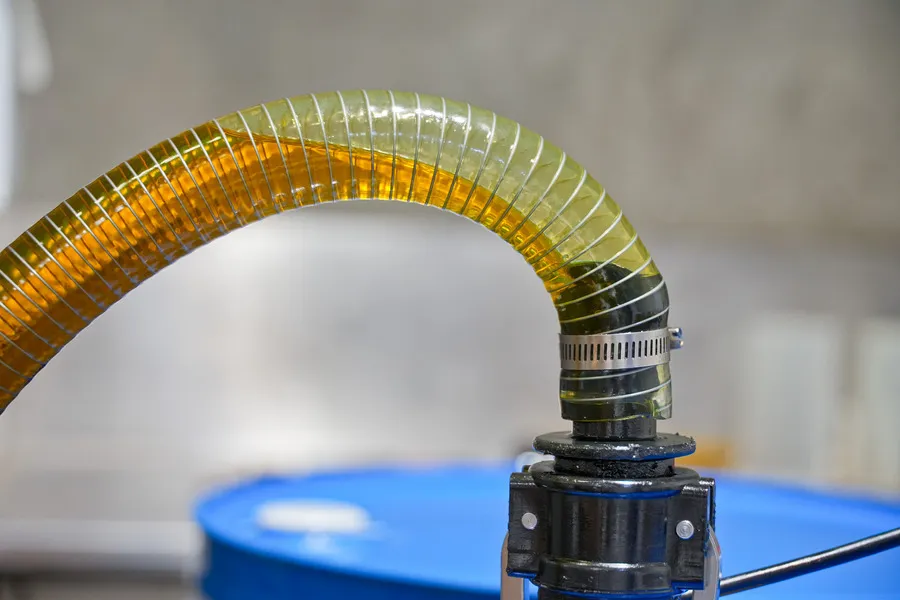
After pressing, the oil is transferred to holding tanks or intermediate bulk containers and allowed to settle for several days. This gives impurities and suspended solids time to move to the bottom. The oil then progresses to filtration, where light, oxygen and heat exposure continue to be controlled before the oil is transferred into the required bulk format.
Settling is not simply an idle period between pressing and packing. It supports filtration by allowing material to separate before the oil moves to the next production stage.
For a more detailed explanation, read How cold pressing affects flaxseed oil.
Sensory Assessment Provides Context, Not Proof of Freshness
Appearance, aroma and taste can provide useful information about the condition of flaxseed oil, particularly where an oil presents an unexpected characteristic or potential off note. However, sensory assessment cannot confirm freshness on its own and should not replace analytical testing, the applicable product specification or batch documentation.
Colour is a good example of this limitation. An older oil may retain the same colour and still return acceptable analytical results. Equally, an oil that falls within the expected colour range may present an unusual aroma or flavour. Buyers should therefore assess sensory characteristics as one part of a wider quality review rather than using appearance as a standalone approval measure.
What acceptable flaxseed oil can look and taste like
The expected appearance, aroma and flavour of flaxseed oil should be defined by the agreed product specification and considered in the context of the intended application.
General descriptions such as creamy, buttery, nutty or grassy are sometimes used to describe flaxseed oil, but they should not be treated as universal indicators of quality. These terms do not appear on Midlands’ production specification, and their relevance will vary according to the oil, grade and finished product.
A food manufacturer developing a mild-flavoured product may have different sensory requirements from a supplement brand, skincare formulator or animal nutrition company. Buyers should determine which characteristics are acceptable within their own product and validate the oil in the intended formulation and process. Where a milder or more neutral ingredient is required, refined flaxseed oil may be an option to discuss.
What deteriorated flaxseed oil can smell or taste like
Deteriorated flaxseed oil may develop noticeable off notes. Midlands’ production team uses descriptors including rancid, painty, putty-like, fishy or musty when identifying characteristics that may make an oil unacceptable. These descriptions reflect practical production experience, but they are not substitutes for laboratory testing.
If an unusual aroma or flavour is identified, the oil should be assessed more broadly. The review may include the applicable specification, analytical results, storage history, transport conditions and container integrity.
For example, an oil may appear to fall within the expected colour range but present a painty or musty note during the supplier’s internal assessment. That observation should prompt further investigation rather than approval based only on appearance. The purpose of the sensory check is to identify a potential concern, not to make a complete technical assessment in isolation.
Analytical Testing Should Support Sensory Assessment
Appearance, aroma and taste can help identify potential concerns, but commercial quality assessment should also include analytical testing and supporting batch documentation. No single sensory characteristic or laboratory result provides a complete definition of quality.
Acid value (AV) and peroxide value (PV) are commonly used as part of flaxseed oil quality assessment. Buyers should confirm which analytical tests apply to the offered grade and ensure the results correspond to the supplied batch.
Commercial approval should consider the product specification, certificate of analysis, analytical results and supplier process controls together, while confirming that the oil is suitable for the intended application.
Quality Evidence for a Bulk Flaxseed Oil Buyer
Protecting Oil from Light, Oxygen, Heat and Moisture
Light, oxygen, heat and moisture can all influence flaxseed oil quality after pressing. For this reason, quality controls should continue throughout settling, filtration, storage and handling rather than ending when the oil leaves the press.
The way oil is collected, transferred, filtered and stored can affect its condition just as much as the pressing process itself. Buyers should therefore understand how exposure is managed throughout production and not rely solely on claims such as "cold pressed" or "nitrogen flushed".
Protection from light starts during production
Limiting light exposure should begin as soon as the oil leaves the press rather than only at the final packaging stage.
At Midlands, oil is collected beneath the presses in a dark-coloured bladder and remains covered during transfers between processing stages. Light exposure is controlled throughout pressing, settling and filtration before the oil is transferred into its final format.
Buyers should ask how exposure is managed during:
- Collection beneath the press
- Transfer between vessels
- Settling
- Filtration
- Storage
- Filling or decanting
- Dispatch
The objective is to minimise unnecessary exposure throughout production rather than relying on the final package alone.
Limiting oxygen exposure continues after pressing
Oxygen exposure can contribute to oil deterioration, making handling practices important throughout production and storage. Buyers should assess not only the storage container itself but also how exposure is managed during processing, transfer and packaging.
Midlands uses food-grade nitrogen during the final filtration stage. The nitrogen displaces oxygen and reduces exposure within the relevant processing stage or container before filling.
When comparing suppliers, buyers should avoid assuming that terms such as "nitrogen flushed" always describe the same process. Useful questions include:
- Where is nitrogen used?
- Is food-grade nitrogen used?
- How is oxygen exposure managed during transfer and storage?
- How does nitrogen use fit within the wider production and handling process?
Moisture exposure also needs to be controlled
Moisture can enter oil through inadequately dried seed, residual water in processing equipment, condensation, damaged packaging or poorly sealed containers.
Increased moisture does not directly cause rancidity or a particular flavour defect. However, moisture can affect the fatty acid profile and make oil less stable or more prone to oxidation. Water can also contribute to elevated free fatty acid (FFA) levels, which may increase the rate at which oil deteriorates over time.
For buyers, this makes dry processing equipment, completely dry containers and secure seals important throughout production, storage and transport.
Key questions include:
- How is seed moisture assessed before processing?
- How are equipment and containers kept dry?
- How is container integrity maintained?
- How are moisture risks managed during storage and transport?
Quality Requirements Depend on the Intended Application
The same underlying quality indicators matter across food, supplement, skincare and animal nutrition applications, but each buyer must evaluate the oil against its own formulation, sensory, regulatory and processing requirements. Quality approval should always be linked to the intended use rather than based only on a generic description.
Food manufacturers
Food manufacturers should confirm that the oil’s specification, sensory profile and handling requirements suit the finished food. Compatibility needs to be assessed within the manufacturer’s own formulation and production process. If a more neutral sensory result is required, refined oil may be worth discussing.
Supplement brands
Supplement brands should use specification-led approval, reviewing relevant batch documentation, oxidation controls, storage requirements and suitability for the chosen capsule, liquid or blended format. The brand and its manufacturer remain responsible for validating the ingredient in the intended product.
Skincare brands
Skincare buyers may consider colour, aroma, oxidation condition, fatty acid profile, batch consistency and compatibility with the intended formulation. Food-grade status alone does not establish performance in a cosmetic product, so the formulator should complete its own technical and regulatory assessment.
Animal nutrition companies
Food-grade and technical-grade flaxseed oils may be available for animal nutrition applications, depending on the customer’s requirements. Technical-grade oil is intended for animal consumption and must not be used in products for human consumption. Buyers should confirm the required grade before ordering.
A Buyers Checklist for High Quality Flaxseed Oil
- Confirm where the seed is grown and what traceability is available.
- Ask how seed is tested and approved before purchase.
- Understand the supplier’s rejection criteria for moisture, maturity, cleanliness and market suitability.
- Confirm the maximum and typical pressing temperatures.
- Ask how light, oxygen, heat and moisture are controlled during processing.
- Confirm whether the oil is settled before filtration.
- Review the applicable product specification and certificate of analysis.
- Understand which analytical tests are completed for the supplied grade.
- Confirm how the supplier conducts its internal sensory release checks.
- Agree the packaging, storage and transport plan for the destination and route.
- Validate the oil within the intended formulation and process.
For wider commercial and operational considerations, read choosing a flaxseed oil manufacturer or supplier.
How Midlands Protects Flaxseed Oil Quality
Midlands applies quality controls from seed selection through production and delivery. These include long-term grower relationships, agronomy support, pre-purchase seed assessment, traceability, controlled cold pressing, settling, filtration, internal sensory assessment, AV and PV testing, covered transfers, food-grade nitrogen and order-specific storage and transport planning.
Food-grade flaxseed oil is available in a range of formats for food, supplement, skincare and animal nutrition applications. Buyers can contact Midlands to discuss specifications, packaging formats, documentation requirements and destination markets.
Expert contribution: This article includes input from Glenys Holden, Production Manager and Oil Specialist at Midlands, who has over 13 years’ experience in flaxseed oil production and Lynnie Scammell, Operations Manager who has worked with flaxseed oil for over a decade. Commentary relating to seed quality, cold pressing, sensory evaluation, quality testing, filtration, storage and handling reflects Midlands’ internal processes and their operational expertise.
Find more answers
Frequently Asked Questions
What makes flaxseed oil high quality?
High quality flaxseed oil begins with suitable seed and depends on controlled pressing, settling, filtration, testing and protected handling. Buyers should review the applicable specification and certificate of analysis, understand the supplier’s process controls and confirm suitability for their intended application.
How can you tell if flaxseed oil is fresh by its colour?
No single visual characteristic confirms freshness. Colour can provide context, but older oil may retain the same colour and return acceptable analytical results. Midlands therefore considers analytical testing and internal sensory assessment alongside appearance rather than treating colour as a standalone approval measure.
What does rancid flaxseed oil smell or taste like?
Potential signs of deterioration include rancid, painty, putty-like, fishy or musty aromas and flavours. These characteristics should trigger further review rather than being used as the only basis for a technical decision.
The batch results, storage history, container condition and applicable specification should also be checked.
Why is flaxseed oil protected from light and air?
Light and air are factors that can contribute to flaxseed oil deterioration, so exposure should be limited during handling, storage and transport. Midlands keeps oil covered during transfers, uses a dark-coloured collection bladder beneath the presses and uses food-grade nitrogen to displace oxygen.
The complete handling process matters, not just the final container.
At what temperature does Midlands cold press flaxseed oil?
Midlands cold presses flaxseed at no more than 38°C, with its presses typically operating at around 28°C. Pressing temperature is one part of quality control and is supported by raw material assessment, controlled processing, settling, filtration, testing and protected handling.
references



Quick Navigation
Contact our team

Steve Williams
BCom (Mgt Sc)
Seed Multiplication Sales Manager
Midlands Seed
+64 27 553 0846seed@midlands.co.nz




Glenys Holden
Production Manager & Oil Specialist
Midlands Nutrition
+64 3 308 1265nutrition@midlands.co.nz
.webp)



