
How Can You Tell Real Manuka Honey?
March 19, 2026
Share this post


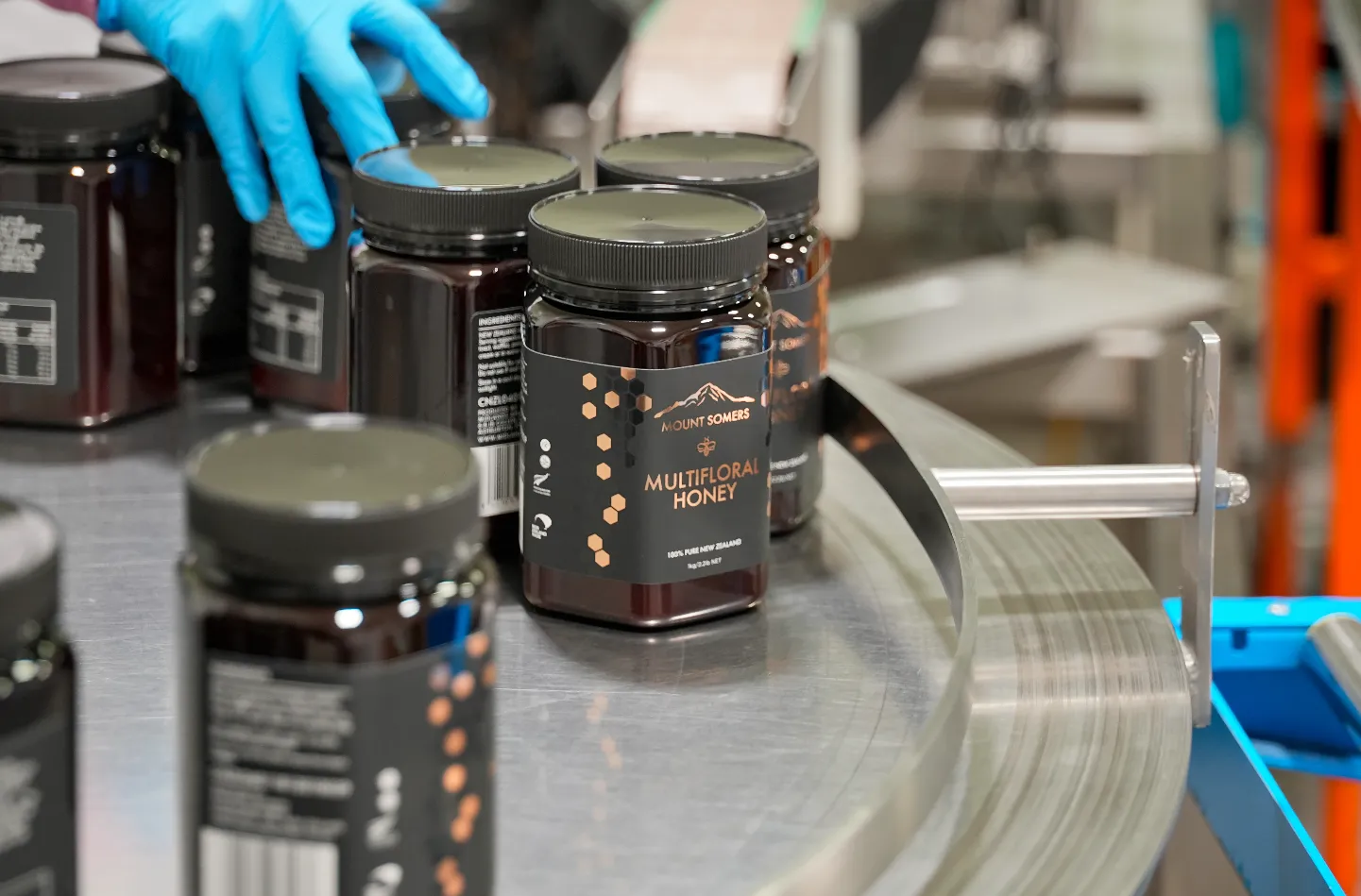
- Check for official certification - UMF (Unique Mānuka Factor) is the gold standard for Mānuka honey grading, confirming the honey was packed in New Zealand and independently tested.
- Avoid vague terms like “active” or “total activity” - these are often unregulated terms that mask a lack of scientific testing.
- Authentic Mānuka honey is expensive to harvest and test. If the price is similar to standard table honey, it’s likely a blend - or fake.
Mānuka honey is one of the most sought-after natural products in the world, prized for its unique properties and rich, earthy flavour. However, its high value has made it a prime target for “honey fraud”.
According to published exports data, annual production is approximately 10,000 tonnes, while global sales labelled as mānuka exceed 50,000 tonnes.
For both health-conscious consumers and commercial buyers, knowing how to tell real mānuka honey isn’t just about getting what you paid for, it’s about building safety and trust in the products you’re consuming or selling.
Midlands Apiaries is here to help you determine the difference between deception and the real deal, by giving you a comprehensive guide on what to look for when identifying authentic Mānuka honey.
The Risk of Adulterated Honey
The global demand for authentic Mānuka honey is driven mainly by its bioactive compounds, specifically Methylglyoxal (MGO). Because high-grade Mānuka honey can retail for significantly more than standard clover, or wildflower honey, unscrupulous suppliers often use several methods to mimic the real thing.
In many cases, fraud honey includes the product undergoing:
Dilution: Blending a small amount of Mānuka with cheaper corn syrup, rice syrup or low-grade honey to increase the appearance of quantity.
Synthetic Spiking: Adding lab-made MGO to non-Mānuka honey to artificially inflate its potency rating.
Mislabelling: Either using vague terms like “active” or “bio-active” to imply health benefits that haven’t been scientifically proven, or making claims about MGO or UMF ratings that aren’t supported by verified testing.
For commercial buyers, the stakes are even higher here. Sourcing fake Mānuka honey can lead to massive financial loss, legal liabilities and, at the end of the day, irreparable damage to brand reputation.
The Key Markers of Authentic Mānuka Honey
To distinguish the “liquid gold” from clever imitation, you’re going to want to look past the marketing and focus heavily on the science behind the jar you’re holding. This Mānuka honey buying guide focuses on the technical markers that guarantee quality.
Certifications and Grading Systems
The most reliable, accurate way to verify real Mānuka honey is through recognised grading systems. We utilise two of them - and they’re both trusted by consumers and retailers around the world.
UMF (Unique Mānuka Factor) is a registered certification system governed by the UMF Honey Association in New Zealand and confirms compliance with specific chemical and quality standards.
It’s a comprehensive quality trademark that verifies the presence of four key markers: Leptosperin, MGO, HMF and DHA. A UMF rating, like UMF 10+, ensures that the honey is packed in New Zealand and independently audited.
MGO Rating (Methylglyoxal) measures the concentration of the primary antibacterial compound that’s found within Mānuka honey. While a high MGO rating is a legitimate marker of potency, it can be added synthetically. Therefore, we believe that MGO is most trustworthy when it’s paired with a UMF logo, or a batch-specific lab report.
Unlike standard honey, genuine Mānuka honey contains a specific chemical “fingerprint” that’s extremely difficult to replicate. Here’s what you’re looking for when it comes to the chemical markers that really matter:
Consider these four markers as a ‘fingerprint’ that proves your Mānuka honey is authentic. Leptosperin is the most important, because it’s a natural compound from the Mānuka flower that is nearly impossible to fake - if it’s there, the honey is legitimate.
Common Red Flags to Watch Out For
If you encounter a deal that seems too good to be true, it probably is. Watch for these warning signs whenever you’re purchasing Mānuka honey.
Vague Labelling: Terms like “active”, “bio-active” or “total activity” are often used to mask a lack of scientific testing. These labels are often unregulated and don’t guarantee the presence of MGO - the very thing that makes Mānuka honey so special.
Unusually Low Price: Authentic Mānuka honey is expensive to produce. It involves remote hive placements that need to be harvested and rigorous laboratory testing. If the price is comparable to a jar of standard table honey, there’s a good chance it’s a blend.
Missing Origin Info: The New Zealand Mānuka honey origin is a protected status. Genuine Mānuka products must be “Packed in New Zealand” to ensure they remain under the strict regulatory oversight of the New Zealand Government. If the honey is exported in bulk drums and repackaged in another country, the chain of custody is broken - which makes it easier to manipulate the product.
No Traceability: Every legitimate jar of Mānuka honey should have a batch number. If a supplier cannot provide a Certificate of Analysis (COA) for that specific batch, there’s good cause to treat their product with suspicion.
What To Do: A Simple Step-by-Step Buyer’s Checklist
Whether you’re buying a single jar of Mānuka honey for your pantry or a pallet for your retail store, follow these steps to ensure that you’ve secured the genuine product and not a fake.
Step 1: Check for the UMF or MGO Label
Look for the registered trademark. For UMF certification, the label must include the UMF quality mark and the rating (like UMF 15+, UMF 20+, etc…). You can read more of our articles on understanding the UMF rating system.
Step 2: Verify the License or Batch Number
On UMF-certified jars of Mānuka honey, you’ll find a license number. You can go to the UMFHA website and search the public database for the brand’s license number, which verifies that the brand is currently authorised to sell Mānuka honey.
Step 3: Confirm the Honey’s New Zealand Origin
Check the label for the “Produced and Packed in New Zealand” claim. New Zealand’s Ministry for Primary Industries (MPI) enforces a strict scientific definition for all Mānuka honey exported from the country.
Step 4: Evaluate Price vs Grade
Expect to pay more for higher MGO/UMF ratings. A UMF 20+ jar requires much rarer nectar and longer maturation than a UMF 5+ jar, so the price should reflect the scarcity.
For those who are sourcing Mānuka honey for retail, cosmetics or pharmaceutical use, due diligence is a business necessity. Consider these points before ordering your batches:
Integrated Traceability: Partner with suppliers like Midlands Apiaries that manage the entire supply chain - from the hives to the jar. This “closed loop” system is a way of ensuring that the honey hasn’t been tampered with during transit.
Understand Monofloral and Multifloral: Monofloral refers to a batch of Mānuka honey that is primarily Mānuka nectar and meets higher chemical thresholds. Multifloral is a blend of Mānuka and other New Zealand wildflowers. Make sure that you know what you’re paying for before you place the order.
Recognise True Mānuka Honey, Receive the Real Deal
Navigating the world of high-value honey will always require a sharper eye and a basic understanding of honey science. This Mānuka honey buying guide serves as a reminder that real Mānuka honey is defined by its transparency.
The more information that your jar of Mānuka honey puts forward, the more confident you can feel in the purchase. From its New Zealand origin to the specific levels of MGO and Leptosperin, every step of that product’s process should be well documented and verified.
By insisting on UMF certification and checking for batch-specific traceability, you’ll protect yourself from the risks of adulterated products. You might be a consumer looking for wellness support, or a commercial retailer looking to stock your shelves with a premium product. The same level of discernment will apply for both.
Looking to source authentic Mānuka honey for your business?
Midlands Apiaries partners with retailers, brands, formulators, and manufacturers worldwide, offering fully traceable, UMF‑certified Mānuka honey from hive to jar. If you’re a business buyer looking for reliable supply, batch‑level documentation, or bespoke sourcing, we invite you to connect directly with Midlands.
Business enquiries: www.midlandsnz.com
Buying Mānuka honey for personal use?
For individual jars and consumer‑ready products, explore PURITI - our premium consumer brand offering 100% New Zealand Mānuka honey, from UMF 5+ through to ultra‑exclusive UMF 31+.
Shop consumer products: www.puriti.com
Find more answers
Frequently Asked Questions
Is MGO Alone Enough to Prove Authenticity?
No. MGO measures antibacterial potency, not floral origin. While it is a legitimate strength indicator, it does not confirm that the honey was produced from Mānuka nectar.
To perform a reliable Mānuka honey authenticity check, buyers should also look for Leptosperin, a naturally occurring compound found only in Mānuka nectar and widely recognised as a strong indicator of origin.
Leptosperin is measured as part of the UMF certification process, which assesses multiple chemical markers together. For this reason, Midlands Apiaries recommends choosing MGO‑graded honey that is supported by UMF certification or batch‑specific laboratory testing.
What is the Minimum MGO to Consider Mānuka Honey Genuine?
To be classified as a genuine Monofloral Mānuka honey product, the industry generally recognises a baseline of MGO 83+, which correlates to a UMF 5+ rating.
Under New Zealand’s strict regulatory framework, ‘genuine’ Mānuka honey is categorised by its nectar purity rather than just potency. To be classified as monofloral Mānuka, the honey must meet specific MPI-set chemical markers that typically correlate with a baseline of MGO 83+ (UMF™ 5+).
Honey that falls below this threshold is classified as multifloral Mānuka. This remains a genuine, trusted Mānuka product, but it indicates that the bees have gathered nectar from a variety of floral sources alongside the Mānuka bush. While multifloral honey is authentic, it does not carry the same concentrated potency or "monofloral" status as higher-rated batches.
Why does the New Zealand Mānuka Honey Origin Matter?
New Zealand origin matters because it guarantees the honey has passed the world’s strictest legal purity tests, under New Zealand government oversight, before it can be exported.
Mānuka honey originating from New Zealand is the only product in the world that’s governed by the Ministry of Primary Industries for its strict scientific definition, so every batch for export needs to pass a rigorous laboratory test, identifying four chemical markers and a DNA marker.
The risk arises when honey is exported in bulk drums to be “re-packaged” in other countries. Once the honey leaves New Zealand shores in bulk, it’s no longer under the protection of national law. In many overseas countries, labelling laws are more relaxed and allows suppliers to blend the authentic Mānuka honey with cheaper clover honey, or corn syrups while retaining the “Mānuka” name on the jar.
To ensure you’re getting genuine Mānuka honey, always look for the “Packed in New Zealand” statement and a valid UMF certification number.
references
Midlands NZ – Honey Products & Resources
Midlands NZ. (n.d.). Manuka Honey Wholesale Supplier. Retrieved from https://www.midlandsnz.com/honey/honey-products/manuka-honey
Midlands NZ. (n.d.). What is MGO and how can it help your Manuka honey business? Retrieved from https://www.midlandsnz.com/honey/honey-resources/what-is-mgo-and-how-can-it-help-your-manuka-honey-business
Midlands NZ. (n.d.). What does UMF mean? Retrieved from https://www.midlandsnz.com/honey/honey-resources/what-does-umf-mean
Midlands NZ. (n.d.). A deep dive into monofloral honey. Retrieved from https://www.midlandsnz.com/honey/honey-resources/a-deep-dive-into-monofloral-honey
Midlands NZ. (n.d.). The difference between monofloral and multifloral manuka honey. Retrieved from https://www.midlandsnz.com/honey/honey-resources/the-difference-between-monofloral-and-multifloral-manuka-honey
Unique Mānuka Factor Honey Association (UMFHA)
UMF Honey Association. (n.d.). About UMFHA. Retrieved from https://www.umf.org.nz/about-umfha/
Ministry for Primary Industries (MPI) – NZ Government
Ministry for Primary Industries. (n.d.). Mānuka honey testing. Retrieved from https://www.mpi.govt.nz/food-business/honey-bee-products-processing-requirements/manuka-honey-testing
Ministry for Primary Industries. (2017). Criteria for identifying mānuka honey: Summary report. Retrieved from https://www.mpi.govt.nz/dmsdocument/17314-Criteria-for-identifying-manuka-honey-Summary-report
PURITI
PURITI. (n.d.). Manuka Honey UMF 10+ | MGO 300. Retrieved from https://www.puriti.com/collections/manuka-honey/products/manuka-honey-umf-10-mgo-300



Quick Navigation
Contact our team

Australia

New Zealand

New Zealand

Tasman Walker
BCom (Mktg) | BSc (Psy)
Honey Sales - Asia & Australia
Midlands Apiaries
+64 27 237 6318honey@midlands.co.nz
Nick Kerr
BCom (Hons)
Honey Sales - North America & Europe
Midlands Apiaries
+64 27 807 9849honey@midlands.co.nz
Hamish Finnie
BSc (Food Sc. & Hum. Nutr.)
Honey Sales - Greater China Region
Midlands Apiaries
+64 27 405 1273honey@midlands.co.nz
%205_Website_-_Resources_Card_750x500.webp)



